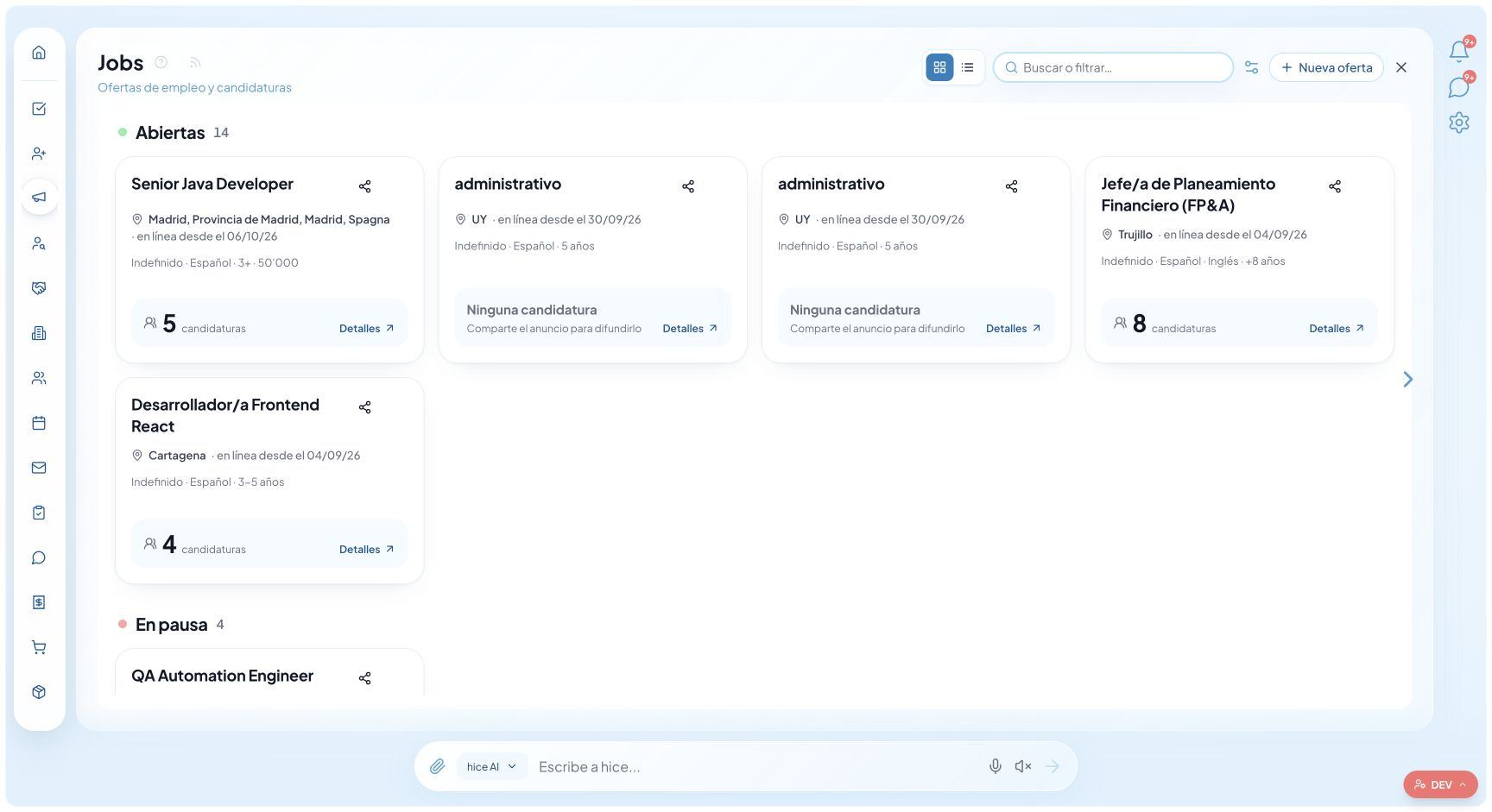
Recruitment agency software that connects candidates, clients and placements
From vacancy to shortlist and hire: ATS, client CRM, candidate database, activity and reporting in one AI-native platform.
When vacancy, job posting, applications, screening, interviews, shortlist, offer and placement live in separate tools
For recruitment agencies and search firms, the problem is not a lack of software but fragmentation. With a standalone ATS, generic sales CRM, inboxes and shared spreadsheets, every handoff creates duplicates, waiting and numbers that disagree. Management sees the delay only after a vacancy, project or month-end close is already at risk.
The same information is copied across a standalone ATS, generic sales CRM, inboxes and shared spreadsheets
No owner can see the complete flow: vacancy, job posting, applications, screening, interviews, shortlist, offer and placement
Reminders, client updates and reports depend on individual memory
Client, candidate and employee databases develop duplicates and conflicting fields
Leadership receives retrospective reports instead of actionable exceptions
The objective — shorten time-to-shortlist and give recruiters and managers the same current record — cannot be measured reliably
HICE connects the work before automating it
HICE uses one data model for vacancy, job posting, applications, screening, interviews, shortlist, offer and placement. AI helps teams search, update and prepare work in natural language; workflows, permissions and approvals keep control with accountable people. The result is an operating platform, not a chatbot placed over untidy data.
“Publish the Data Engineer vacancy and connect every application to Acme” → a traceable pipeline
“Which Python candidates have we interviewed in the last 18 months?” → evidence-based talent pool
“Prepare the client shortlist with CVs, notes and availability” → consistent submission pack
“Show placements, conversions and stalled vacancies by recruiter” → live operations report
Try it in chat
Examples you can ask:
Static demo of hice's AI chat.
What you get
One source of truth
Clients, people, requests, activity and outcomes across vacancy, job posting, applications, screening, interviews, shortlist, offer and placement remain connected and searchable.
AI on operational data
Ask for searches, summaries, updates and actions in chat while permissions and audit history stay active.
Workflow and ownership
Stages, owners, next actions, due dates and approvals make stalled work visible.
Connected CRM and people data
Companies and contacts are not separated from candidates, consultants, projects and operating history.
Time, projects and margin
Operations continue after placement through assignments, timesheets, expenses and project economics.
Exception-based dashboards
Measure what matters to shorten time-to-shortlist and give recruiters and managers the same current record without rebuilding an Excel report.
How to design the end-to-end workflow
Start with decisions, not screens. For recruitment agencies and search firms, the minimum flow should describe vacancy, job posting, applications, screening, interviews, shortlist, offer and placement. Every stage needs entry and exit criteria, an owner, a next action and a date. A stage that changes no decision probably does not belong in the workflow.
Separate the standard path from exceptions. Software should make frequent work immediate and surface incomplete cases. Document the handoffs among sales, recruiting, delivery and finance because that is where context and accountability most often disappear.
Owner and SLA for each handoff
Required fields only when needed
A visible next action
History of decisions and approvals
Which data belongs in the same platform
One platform does not mean one giant table. It means consistent identities and explicit relationships: a client has contacts and requests; a person can become a candidate, consultant or employee; a request can create activities, interviews, a project, an assignment and time. That structure removes duplication caused by a standalone ATS, generic sales CRM, inboxes and shared spreadsheets.
Choose a system of record and update rule for every field. Skills, availability, rate, consent, stage and owner need shared definitions. Before migration, remove duplicates, ownerless records and obsolete stages; moving dirty data makes disorder faster, not better.
Clients, contacts and requests
Candidates, employees and consultants
Projects, assignments and rates
Activities, time, expenses and approvals
What to automate and where humans remain accountable
Automate transfers, reminders, summary preparation, completeness checks and approval routing. These are high-volume activities with a testable rule. Keep a named person accountable for hiring decisions, assessments, commercial terms, rate overrides and financial close.
For every automation, define its trigger, source data, expected output, exceptions and reversal path. AI can extract and organize evidence; it should not invent requirements or make opaque employment decisions. Permissions and audit trails make speed governable.
Automatic reminders and routing
Assistive AI, not a hidden decision-maker
Approval for sensitive actions
Complete logs and reversible actions
Implementation and KPIs that prove the result
Pilot a journey that genuinely crosses vacancy, job posting, applications, screening, interviews, shortlist, offer and placement; do not stop at importing contact records. Select a representative team, client or project group, complete one cycle and reconcile outputs with current sources. Expand only after evidence is trusted and parallel trackers can be retired.
The baseline must show whether you are succeeding at shorten time-to-shortlist and give recruiters and managers the same current record. Measure cycle time, overdue actions, duplicates, reconciliation hours, adoption and data quality. Add availability, utilization, approved time and margin for staffing or consulting; add time-to-shortlist, stage conversion and vacancy aging for recruitment.
Baseline before go-live
End-to-end pilot
Two reconciled cycles
KPI review at 30, 60 and 90 days
Operating example: a 14-recruiter agency
The agency kept clients in its CRM, candidates in its ATS and progress in a shared tracker. Every client update required manual reconstruction. With HICE, the commercial request creates the vacancy, candidates remain connected to interviews and feedback, and the placement closes the same flow. The director sees workload, conversion and next actions without asking each recruiter for a report.
HICE versus a stack of separate tools
Feature
hice.ai
Fragmented stack
Data model
Connected clients, people and work
a standalone ATS, generic sales CRM, inboxes and shared spreadsheets
Handoffs
Owned workflow with history
Email, chat and copy-paste
Automation
Across the end-to-end process
Local automations inside each tool
AI
Searches and updates every module
Copilot without operating context
Reporting
Live and exception-based
Periodic consolidation
Adoption
Chat plus full interface
Different forms in every system
FAQ
Who is recruitment agency software for?+
It is for recruitment agencies and search firms that need to run vacancy, job posting, applications, screening, interviews, shortlist, offer and placement without maintaining disconnected databases and trackers.
Does HICE replace ATS, CRM and timesheets?+
It can when the scope needs candidates, clients, staffing, projects and time in one system. It can also be introduced in phases alongside current tools during migration.
Can we import Excel, CRM or ATS data?+
Yes. Migration starts with mapping, deduplication and record checks so useful history remains available without importing the old disorder.
Does AI decide who gets hired?+
No. AI helps extract, search, summarize and organize information. Accountable recruiters and managers make employment decisions.
How are roles and sensitive data handled?+
Role-based permissions, action history and information boundaries limit access to CVs, rates, costs and commercial data.
Can we begin with one process?+
Yes. Start with recruiting, CRM, staffing, projects or timesheets and connect further workflows when the team is ready.
Which KPIs should we measure?+
Measure cycle time, overdue actions, data quality and the specific outcome: shorten time-to-shortlist and give recruiters and managers the same current record. Then add conversion, utilization or margin for your business model.
Is there a free plan?+
Yes. HICE is free for companies with up to 10 employees and 5,000 CVs, or freelancers with up to 2,000 CVs, with no card required.
Bring vacancy, job posting, applications, screening, interviews, shortlist, offer and placement into one platform
Start free or book a demo built around your real workflow.