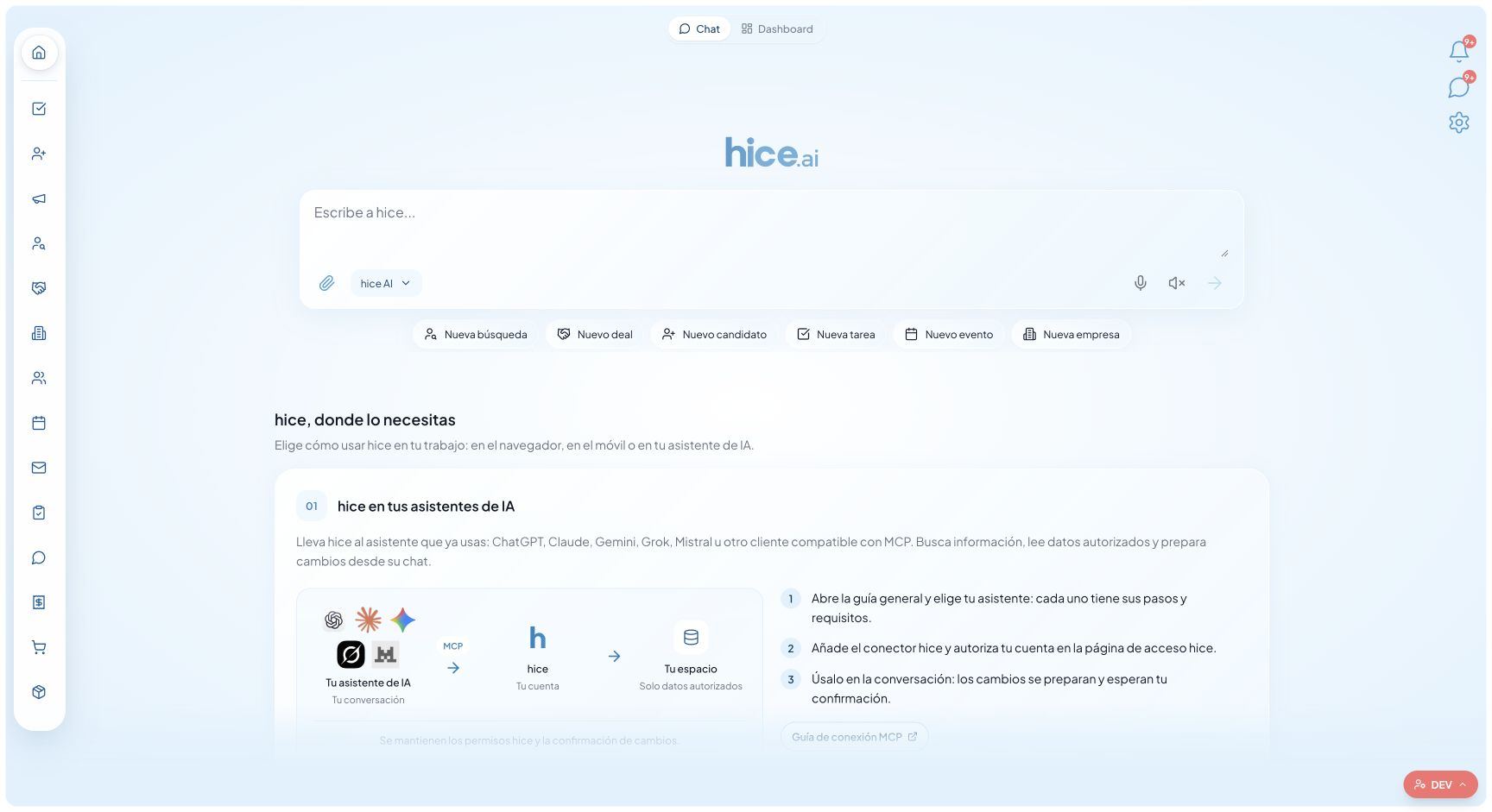
Consultant staffing in 10 seconds

    AI reads the client request, searches the database, proposes the top 3 candidates ranked by match. You confirm, AI prepares the proposal.

    Manual staffing is the bottleneck

    Every client RFP requires hours: read JD, filter database, contact candidates, verify availability, prepare proposal. Time that becomes lost opportunities to faster competitors.

    • RFPs queued for days
    • Database with thousands of CVs hard to search
    • Consultant availability always to verify by hand
    • Proposals built in Word from scratch every time
    • Bench unmonitored: idle consultants while compatible requests come in

    AI-driven staffing, end-to-end

    hice.ai automates the whole flow: from JD reading to signed proposal. Manager stays in control, AI handles the repetitive work.

    • "Client Enel asks for 2 senior AWS Cloud Architects, 12 months, Rome"
    • "Notify Anna and Luca they've been proposed for the BNL project"
    • "Generate a commercial proposal for Generali with the data engineering team"
    • "Update Marco's availability from February 1"
    Try it in chat

    Examples you can ask:

    Static demo of hice's AI chat.

    What you get

    AI parsing of JDs and CVs

    Automatic extraction of skills, seniority, location, duration, rate.

    Match scoring

    Compatibility score candidate-project with explanation.

    Calendar integration

    Real consultant availability based on existing allocations.

    Proposal generator

    Commercial PDF documents generated with one command.

    Bench radar

    Auto alerts when JDs match benched consultants.

    Visual pipeline

    Status of each proposal: sent, in evaluation, won, lost.

    The data without which no staffing proposal is reliable

    No intelligence layer compensates for an incomplete inventory. For an assignment proposal to be useful you need five datasets: profiles with dated skills, a real availability calendar with leave and contracted hours, current assignments with allocation percentage, demand with roles and time windows, and role economics.

    If one is missing, the system degrades predictably. Without leave, it proposes people who will be away. Without allocation percentage, it confuses someone partly booked with someone free. Without skill dates, it proposes expired experience. Fixing the data is worth more than widening the feature set.

    • Skills with level, evidence and verification date
    • Availability with leave, working hours and internal commitments
    • Assignments with allocation percentage and end date
    • Sell rate and cost by role with separate permissions

    Scenarios instead of a single recommendation

    A ranked list hides the alternatives. In practice a good answer to a staffing request takes four shapes: the ideal option that is probably unavailable, the available option with an identified gap and a plan to close it, the one that delays the start by two weeks to free the right profile, and the mixed option pairing a part-time senior with someone developing.

    Presented that way, the client conversation changes in nature. Instead of negotiating over a single proposal, you negotiate over an explicit trade-off between date, profile and price, which is a far stronger position and usually ends better for both sides.

    • Several alternatives with impact on margin, risk and date
    • Skill gaps flagged with their coverage plan
    • Resequencing options when the ideal profile is busy
    • Effect of each scenario on team development

    Watching the bench before it appears

    The bench is almost never a surprise: it is an assignment ending on a known date with nothing behind it. What is missing is somebody looking at that date early enough to act commercially.

    A fifteen-minute weekly routine focused only on exceptions handles most of it. It should show who finishes an assignment in the next six weeks, which tentative bookings have expired, which probable demand could absorb that capacity and which skills are going unused. Every line needs an owner and a date, not just an observation.

    • Assignment end visible weeks in advance
    • Tentative bookings with a confirm-or-release date
    • Cross-check between capacity freeing up and probable demand
    • Actions with an owner and a date, not just alerts

    150-consultant body rental firm

    Staff manager processed 25 RFPs/week, 20 minutes each = 8+ hours. With hice.ai: 25 × 2 minutes = under one hour. 7 hours/week freed for higher-value commercial activities.

    hice.ai vs manual staffing or classic ATS

    Featurehice.aiClassic ATS
    Time to process an RFP2 minutes20-30 minutes
    AI matchingNativeManual filters
    Real-time availabilityYesVerify by hand
    Auto commercial proposalYesManual Word
    Bench alertsYesNo
    License costIncluded in PSASeparate tool

    FAQ

    What does staffing in consulting mean?+

    The process of assigning consultants to client projects: skill matching, availability check, commercial proposal, contracting.

    How many CVs can I upload?+

    No practical limits. Database scalable to firms with thousands of candidates.

    Does AI read multilingual CVs?+

    Yes, multi-language parsing. AI normalizes skills and roles for searchability.

    Can I integrate LinkedIn?+

    Manual CV import or via Chrome extension. Direct LinkedIn API on roadmap.

    How does match scoring work?+

    AI evaluates required vs present skills, seniority, location, availability, past client experience. Output: score + explanation.

    Can I customize commercial proposals?+

    Yes. Company templates, branding, customizable sections. AI fills project data.

    Integrate with Salesforce for pipeline?+

    Yes, REST API. But many firms replace Salesforce with hice.ai for the consulting pipeline.

    Works for pure recruiting too?+

    Yes. ATS module is complete: candidate pipeline, interviews, offers.

    Turn RFPs into deals in minutes, not hours

    30-minute demo or instant free access.